How to Choose Between Lymphatic Massage and Deep Tissue Massage in Bali
Lymphatic Massage vs Deep Tissue is a common question for people in Bali who feel swollen, sore, heavy, tense, or physically tired but are unsure which treatment will actually help. Choosing the wrong massage can sometimes leave you feeling more uncomfortable, especially when your body needs a gentle approach rather than stronger pressure.
A traveler may arrive in Bali after a long flight with swollen ankles and heavy legs. A digital nomad may spend ten hours working at a laptop and develop tight shoulders and neck tension. Another client may be recovering from a procedure and need a treatment that respects the body’s healing process.
These situations may all involve discomfort, but they do not always require the same type of massage.
This is why understanding Lymphatic Massage vs Deep Tissue is more useful than simply choosing the massage with the strongest pressure. In practical treatment experience, the best option depends on what your body is experiencing, your current condition, your recovery stage, and the result you want from the session.
If you are looking for a lymphatic massage in Bali or considering a deep tissue massage in Bali, this guide will help you understand the real differences between the two treatments and how to choose the right option for your needs.
Lymphatic Massage vs Deep Tissue: The Main Difference
The most important difference between Lymphatic Massage vs Deep Tissue is the treatment goal.
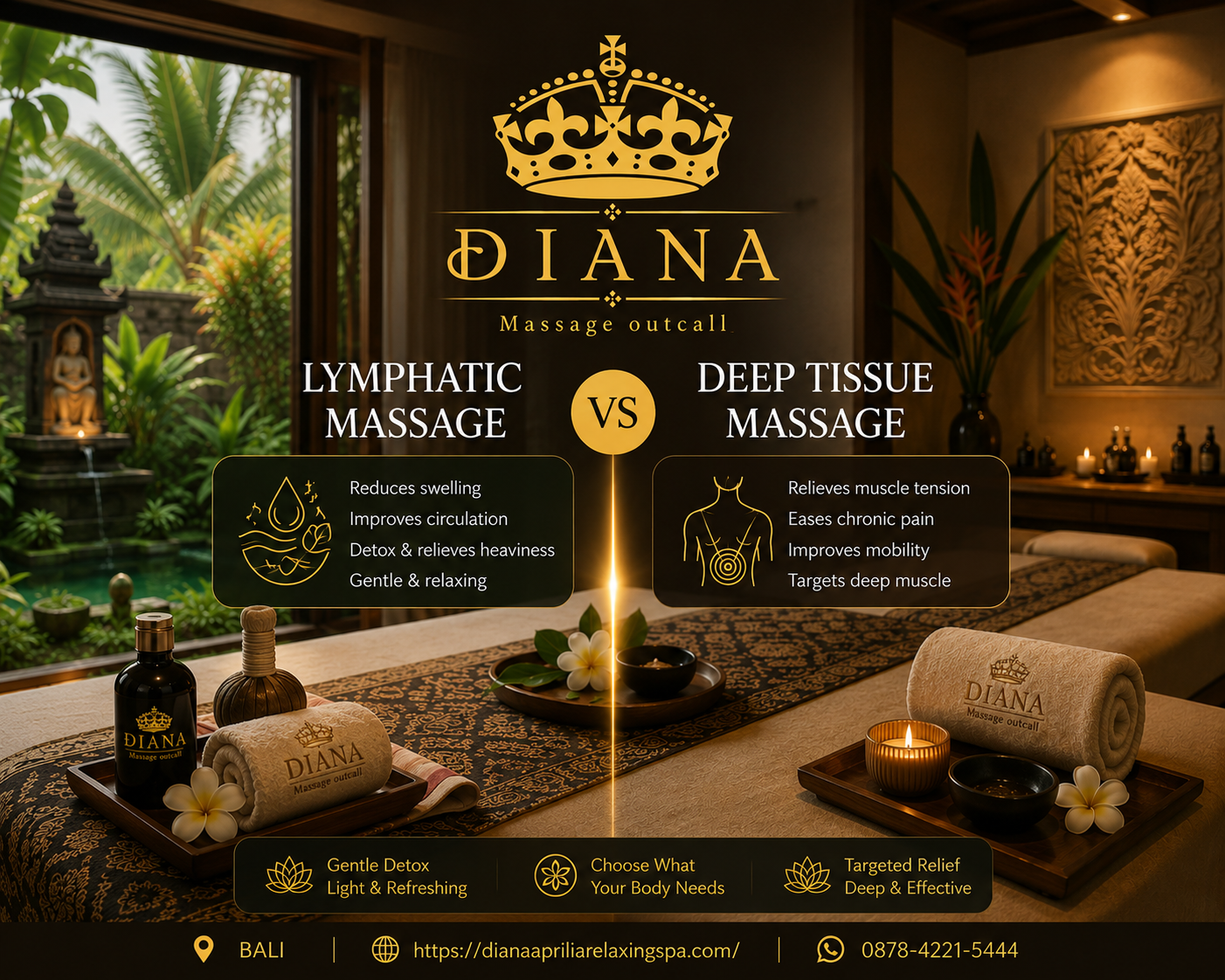
Lymphatic massage generally uses gentle, rhythmic movements designed to support fluid movement and promote a feeling of lightness. It is often chosen by people who experience swelling, fluid retention, heaviness, or who want a gentler treatment approach.
Deep tissue massage uses more focused and firm pressure to address muscle tension and areas of tightness. It is commonly chosen by people with muscular stiffness, chronic tension, or discomfort related to physical activity and repetitive postures.
However, the difference is not simply gentle pressure versus strong pressure.
The more important question is what your body actually needs.
A client with swollen legs after a long flight may not benefit from aggressive pressure. A person with severe muscular tightness may not get the result they want from a very gentle lymphatic treatment.
This is why a proper consultation matters before choosing between Lymphatic Massage vs Deep Tissue.
What Is Lymphatic Massage Used For?
Lymphatic massage is often selected by clients who want a gentle treatment focused on supporting the body’s natural fluid movement.
In daily practice, many people who ask for lymphatic massage are not necessarily looking for a traditional massage experience. They may be looking for relief from a feeling of heaviness, puffiness, or temporary swelling.
Some common reasons clients consider a lymphatic massage in Bali include:
• Swollen feet or ankles after a long flight
• A feeling of heaviness in the legs
• Temporary fluid retention
• Recovery support after certain procedures, with appropriate medical clearance
• A desire for a gentle and relaxing treatment
• Feeling physically heavy after long periods of sitting
• General discomfort related to travel and changes in routine
One of the most common situations we see in Bali involves travelers arriving after many hours on a plane.
They may say that their legs feel heavy, their shoes feel tighter, or their ankles look more swollen than usual. Their first instinct is often to request a strong massage.
However, strong pressure is not automatically the best solution for every type of swelling.
This is one of the most important lessons when comparing Lymphatic Massage vs Deep Tissue.
A treatment should be selected based on the condition being addressed, not simply based on how intense the massage feels.
What Is Deep Tissue Massage Used For?
Deep tissue massage is usually more suitable when the main problem involves muscular tension and tightness.
Clients often consider deep tissue massage in Bali after physical activity, long working hours, repetitive movement, or ongoing muscle tension.
Common reasons include:
• Tight shoulders and upper back
• Stiffness in the neck
• Lower back muscle tension
• Muscle soreness after exercise
• Tight legs after physical activity
• Persistent muscular discomfort
• General body tension caused by posture and repetitive movement
Deep tissue massage may involve slower and more focused work on specific muscle groups.
The goal is not simply to make the treatment painful. Effective deep tissue work should be controlled, responsive, and adjusted according to the client’s tolerance and physical condition.
A common mistake is assuming that the strongest possible pressure will always produce the best result.
In practical experience, this is rarely that simple.
A client who has already been physically exhausted, dehydrated, or overstimulated may not need an extremely intense session. The right pressure should support the treatment goal rather than create unnecessary discomfort.
Lymphatic Massage vs Deep Tissue for Swelling
When swelling is the main concern, the choice between Lymphatic Massage vs Deep Tissue deserves careful consideration.
Temporary swelling can happen for many reasons, including long periods of sitting, travel, changes in activity, and other factors.
A person who arrives in Bali after a long flight may notice swelling around the ankles and feet. In this situation, the body may feel heavy rather than muscularly tight.
This is where a gentle lymphatic approach may be more appropriate than immediately choosing deep tissue pressure.
Deep tissue massage is primarily designed to address muscle tension. It is not automatically the correct treatment for every type of swelling.
A professional consultation can help determine whether the main issue appears to be muscular tension, fluid related heaviness, or a combination of different factors.
This is why choosing a professional lymphatic massage Bali service should involve more than simply booking the first available treatment.
The practitioner should understand what you are experiencing and adjust the session accordingly.
Lymphatic Massage vs Deep Tissue for Muscle Tension
If your primary concern is tight muscles, the comparison may point more clearly toward deep tissue massage.
For example, a digital nomad who spends most of the day working on a laptop may experience tight shoulders and upper back tension. The main problem may be muscular rather than fluid related.
In this case, a focused deep tissue treatment may be more appropriate.
However, not every person with muscle tension automatically needs deep pressure.
Some clients experience general fatigue, mild tension, and a feeling of heaviness at the same time. A treatment plan may need to be adjusted based on which symptom is most important at that moment.
This is another reason why the decision between Lymphatic Massage vs Deep Tissue should not be based only on online descriptions.
Your symptoms, lifestyle, recent activities, and current physical condition all matter.
Which Massage Is Better After a Long Flight?
After a long flight, many travelers in Bali experience heavy legs, swollen feet, stiffness, and general fatigue.
The right treatment depends on what you are feeling.
If the main concern is swelling and a heavy sensation, a gentle lymphatic approach may be worth considering.
If the main issue is muscular stiffness from sitting in one position for many hours, a carefully adapted massage may be more appropriate.
Some travelers experience both.
This is why a short consultation before treatment can be valuable.
A practitioner can ask about your flight duration, current symptoms, recent physical activity, and any relevant health or recovery considerations.
The answer to Lymphatic Massage vs Deep Tissue is therefore not always the same for every traveler.
Two people can arrive on the same flight and require completely different treatments.
Which Massage Is Better After Exercise?
After exercise, the decision between Lymphatic Massage vs Deep Tissue depends on the type of discomfort you are experiencing.
If your muscles feel tight and sore after training, hiking, surfing, cycling, or other physical activities, deep tissue massage may be considered.
However, intense pressure is not always appropriate immediately after strenuous physical activity.
If your body feels generally exhausted, sensitive, or overly sore, a lighter treatment may be more comfortable.
The goal should be to help your body feel better, not to prove how much pressure you can tolerate.
A practical approach is to explain exactly what you did before the treatment.
Tell your practitioner whether you went hiking, surfing, cycling, running, or spent the day walking around Bali.
This information can help the practitioner adapt the treatment to your current condition.
Lymphatic Massage vs Deep Tissue After Cosmetic Procedures
This is an area where professional judgment and appropriate medical guidance are especially important.
Some clients travel to Bali while continuing recovery after a cosmetic procedure performed elsewhere.
They may already have experience with lymphatic treatments and want to continue their recovery routine during their holiday.
In these situations, treatment should not simply repeat the same routine every time.
The body changes during recovery.
Some areas may still have swelling while others become more comfortable. The approach may need to be adapted according to the client’s healing progress and any instructions provided by their medical professional.
For anyone considering Lymphatic Massage vs Deep Tissue after a procedure, it is important to understand that deep tissue massage may not be suitable during certain stages of recovery.
Medical clearance may be necessary depending on the procedure and individual circumstances.
A responsible practitioner should never treat post procedure recovery as a standard massage booking.
Real Experience From Daily Practice
One of the clearest ways to understand Lymphatic Massage vs Deep Tissue is to look at the situations clients actually experience.
Case Study 1: A Traveler With Swollen Ankles
One traveler from Australia arrived in Bali after a twelve hour flight.
Her ankles were visibly swollen, and she described her legs as heavy. Her first assumption was that she needed deep tissue massage because the heaviness felt uncomfortable.
After discussing her symptoms, the treatment approach was adjusted toward gentle lymphatic drainage rather than immediately using strong pressure.
The following morning, she reported feeling noticeably lighter and more comfortable while walking around Canggu.
The important lesson was not that lymphatic massage is always better than deep tissue massage.
The lesson was that the treatment should match the actual problem.
Case Study 2: A Client Continuing Recovery
Another client visited Bali several weeks after undergoing a cosmetic procedure overseas.
She had already received several treatments before arriving and wanted to continue supporting her recovery while enjoying her holiday.
Instead of repeating the exact same routine during every appointment, the treatment was adjusted according to her progress.
Some sessions focused more on areas with remaining swelling. Later sessions focused more on comfort and mobility as her condition changed.
This type of situation demonstrates why the choice between Lymphatic Massage vs Deep Tissue should consider timing and recovery stage.
A treatment that may be appropriate for one person may not be suitable for another person at a different stage of recovery.
Case Study 3: Digital Nomads With Daily Tension
Many digital nomads in Bali spend long hours working from laptops.
They may experience neck tension, tight shoulders, mild fluid retention, and general fatigue at the same time.
In these cases, simply choosing the strongest massage is not always the most effective strategy.
The treatment may need to address the most significant problem first.
A client with primarily muscular tension may benefit from focused work on the shoulders and upper back.
A client who feels heavy and mildly swollen after long periods of sitting may prefer a gentler lymphatic approach.
The practical lesson is simple.
Successful treatment is not about using the strongest pressure.
It is about understanding the client’s condition and responding appropriately.
How to Choose Between Lymphatic Massage and Deep Tissue Massage
If you are still unsure about Lymphatic Massage vs Deep Tissue, start by asking yourself what you want to improve.
Choose Lymphatic Massage If Your Main Concern Is:
• Swelling or puffiness
• Heavy legs
• Temporary fluid retention
• A gentle treatment experience
• Recovery support where appropriate and medically cleared
• Feeling physically heavy after travel or long periods of sitting
Consider Deep Tissue Massage If Your Main Concern Is:
• Tight muscles
• Persistent muscular tension
• Stiff shoulders
• Upper back tightness
• Muscle soreness after physical activity
• Specific areas of muscular discomfort
These are general guidelines rather than a substitute for professional assessment.
If you have a medical condition, unexplained swelling, recent surgery, or significant symptoms, it is important to seek appropriate medical advice before booking a massage.
Can You Combine Lymphatic Massage and Deep Tissue Massage?
In some situations, clients may benefit from a treatment plan that includes different approaches at different times.
However, this does not necessarily mean combining intense deep tissue pressure with lymphatic techniques during one session.
The better approach may be to understand the primary goal of each appointment.
For example, a client may focus on gentle lymphatic work when swelling and heaviness are the main concerns.
At another time, the same client may choose targeted muscular treatment when muscle tension becomes the primary issue.
The best approach depends on the individual.
This is why experienced practitioners do not treat every appointment as an identical routine.
What Should You Tell Your Massage Therapist Before Treatment?
Before booking a lymphatic massage Bali treatment or deep tissue massage, share relevant information about your current condition.
Useful details include:
• When your symptoms started
• Whether you recently took a long flight
• Recent exercise or physical activity
• Areas of swelling or discomfort
• Recent procedures or surgery
• Any medical guidance you have received
• Whether you prefer gentle or firmer pressure
• Your main goal for the treatment
The more clearly you explain your situation, the easier it is to choose an appropriate treatment approach.
A professional consultation should be part of the experience rather than an unnecessary extra step.
Common Mistakes When Choosing Between Lymphatic Massage vs Deep Tissue
Choosing the Strongest Massage Automatically
Many people assume that stronger pressure means better results.
This is one of the most common mistakes.
Deep pressure may be useful for certain types of muscular tension, but it is not automatically suitable for swelling, recovery, or every type of discomfort.
Booking Based Only on Price
The cheapest massage is not always the best value.
A treatment that does not match your needs may leave you feeling that the session was ineffective.
A better question is whether the practitioner understands your goal and can adapt the treatment appropriately.
Ignoring Recent Travel or Physical Activity
Your body may respond differently to massage after a long flight, intense exercise, or a full day of physical activity.
Always share this information before treatment.
Assuming Everyone Needs the Same Treatment
Two clients can have similar symptoms but completely different causes.
This is why personalized assessment is important when comparing Lymphatic Massage vs Deep Tissue.
Why Professional Experience Matters in Bali
Bali attracts travelers with different lifestyles and physical needs.
A visitor may spend one day relaxing at a villa, the next day hiking, and the following day working from a laptop.
Another person may arrive after a long flight and immediately begin exploring the island.
A professional massage service should understand that these clients do not all need the same treatment.
Experience helps practitioners recognize patterns and ask better questions.
The goal is not to force every client into one standard massage routine.
The goal is to understand the client’s situation and select an approach that makes practical sense.
This is particularly important for people searching for Lymphatic Massage vs Deep Tissue in Bali because the right choice depends on the person rather than the popularity of the treatment.
FAQ About Lymphatic Massage vs Deep Tissue
Is lymphatic massage better than deep tissue massage?
Neither treatment is universally better.
Lymphatic massage may be more suitable for clients who want a gentle approach focused on fluid movement and a feeling of lightness.
Deep tissue massage may be more suitable for people experiencing muscular tightness and specific areas of tension.
The right choice depends on your symptoms and treatment goals.
Can I get deep tissue massage if I have swelling?
It depends on the cause and nature of the swelling.
Swelling should not automatically be treated with strong pressure.
If you have unexplained, severe, sudden, or persistent swelling, seek appropriate medical advice before booking a massage.
For temporary heaviness after travel, a consultation can help determine whether a gentler approach may be more appropriate.
Which massage is better after a long flight in Bali?
If your main concern is heavy legs and temporary swelling, lymphatic massage may be worth considering.
If your main concern is muscular stiffness from sitting for many hours, a carefully adapted massage may be more suitable.
Because every traveler responds differently, discussing your symptoms before treatment is recommended.
Is lymphatic massage painful?
Lymphatic massage is generally associated with a gentle treatment approach.
The experience should not be based on intense pressure or pain.
However, individual sensitivity can vary, so it is always important to communicate with your practitioner during the session.
How often should I get lymphatic massage?
The ideal frequency depends on your goals, personal condition, and any medical recommendations that apply to you.
Some clients book a single treatment after travel, while others follow a treatment plan for a specific recovery goal.
A professional should recommend frequency based on your individual situation rather than applying one schedule to everyone.
Can I book a lymphatic massage at home in Bali?
Yes, many travelers prefer a lymphatic home massage in Bali because it allows them to receive treatment at a villa, hotel, or suitable accommodation.
Home massage can be particularly convenient after a long flight or when you prefer not to travel to a spa.
Before booking, confirm the service area, treatment type, practitioner experience, and any relevant requirements.
Final Thoughts on Lymphatic Massage vs Deep Tissue
Choosing between Lymphatic Massage vs Deep Tissue should not be based on which massage sounds stronger or more intense.
The better question is what your body actually needs today.
If your main concern is swelling, heaviness, or a desire for a gentler treatment, lymphatic massage may be a more suitable option.
If your main concern is muscular tightness, stiffness, or specific areas of tension, deep tissue massage may be worth considering.
For travelers in Bali, the decision can also depend on your recent flight, physical activity, lifestyle, and recovery stage.
From practical experience, the most effective treatment is rarely about applying the maximum amount of pressure.
It is about selecting the right approach for the right situation.
If you are still unsure which treatment is best for you, a consultation can help you make a more informed decision before your session begins.
Looking for a personalized treatment in Bali? Explore our Lymphatic Massage Bali service and speak with our experienced practitioners about your current needs, whether you are looking for gentle lymphatic support, targeted muscular treatment, or guidance on choosing between both approaches.
Book your massage in Bali today and choose a treatment based on what your body actually needs.